October 23, 2026
"Mine!" What We're Learning About Sharing
"When will my child learn to share?" It is one of the questions families ask us most. This fall, two moments from our programs, one in the sandbox with our toddlers and one in a cardboard house with our older children, gave us a fresh way to think about it.
Why sharing is so hard
When a young child shouts "Mine!", it is not selfishness. It is a big, honest message: I want this, and I don't know how to get it yet.
Sharing asks a lot of a small person. They have to wait. They have to cope with disappointment. They have to read another child's face, find the right words and trust that their turn really will come. Those are skills, and like any skill, they are learned with practice and support.
"MINE!" in the sandbox
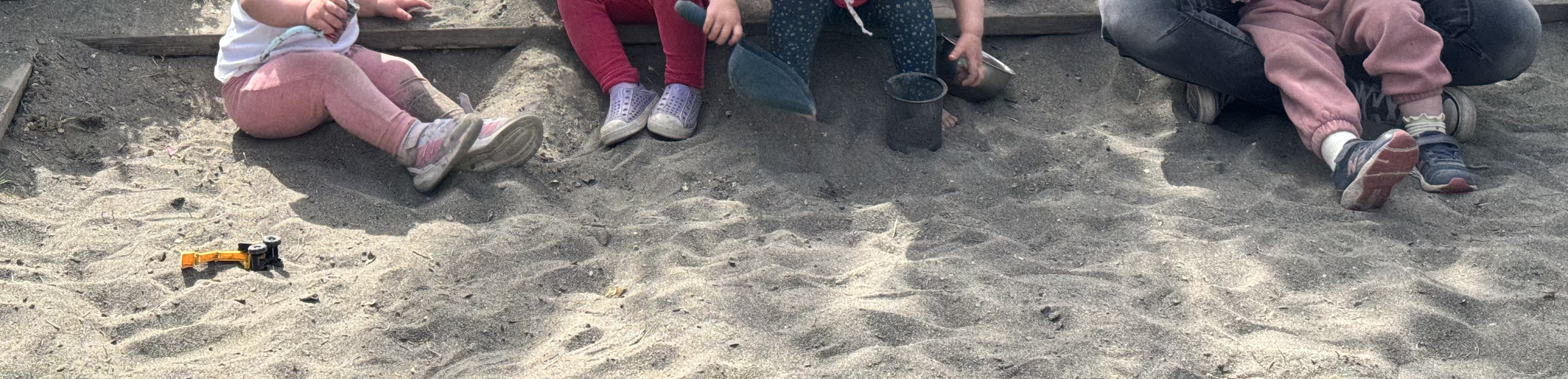
As I walked toward the sandbox one morning, I heard it: "MINE!" A toddler sat with his head down as a bulldozer rolled away in the hands of another child who had it first.
I started with his feelings. "I hear you. That's hard. You want a turn." Then I offered him words he could borrow: "Turn please." The other child looked back silently, so I offered her words too: "When I'm finished." I carried those words between them until they could begin to hear each other.
Waiting was still hard, so we found a dump truck and started our own construction site. Little by little, the other child drifted closer. Soon she was filling the back of his dump truck with her bulldozer, and another child joined with a confident "Yep!" What began as "mine" became a shared job, with a whole crew scooping and dumping together.
"There's not enough room"
In another program, one of our older children had built herself a house of cardboard blocks, just big enough for one. From inside it she called out, "No one wants to play with me." When I asked if she had invited anyone, she paused. "Well, no." So she asked, and a younger child joined her.
Then a third child asked to come in. "There's not enough room," she said. Instead of telling her she had to share, I wondered with her: "What might happen if we look at all the blocks and think about how we could welcome others in?" She looked around. "Um, actually there are enough blocks." By the end of the morning, a house for one had become a home for many.
What these moments taught us
- Feelings come first. A child who feels heard is far more ready to wait or let go.
- Children need words to borrow. "Turn please" and "When I'm finished" give children a way to ask and to answer, instead of grabbing or refusing.
- Wondering works better than insisting. "You need to share" ends the conversation. "I wonder how we could make room?" invites a child to solve the problem herself, and to feel proud of the answer.
- Sharing grows with time. Later this fall, I watched five children work around one marble run without a single reminder from an adult. That didn't happen in a day. It grew from months of relationships and many small moments just like these.
We hold two values side by side: everyone is welcome, and children have a right to choose how and with whom they play. Sharing isn't about forcing a child to hand something over. It is about helping them discover there is often room for one more.
Bringing it home
- Name the feeling. "You really want that truck. It's hard to wait." Acknowledging the feeling doesn't mean giving in.
- Offer words to try. Practise "Can I have a turn?" and "When I'm finished" at home, so they are ready when it matters.
- Make waiting easier. Suggest something else to do in the meantime.
- Wonder out loud. In a sibling squabble, try "I wonder how you could both use the blocks?" before stepping in with a solution.
- Protect what's special. Before a playdate, let your child put away one or two treasured things. Not everything has to be shared.
- Be patient. Every "mine" is a chance to practise. The sharing will come.
We would love to hear what sharing looks like in your home. Share a moment with your child's educators at pick-up. These stories are always better when we tell them together.
-Lauren-